COMMUNICATOR
Prominent members of a profession customarily engage in frequent lecturing and writing. Giroud is characterized by a combination of traits that sets him apart as a communicator: in addition to passion for engineering, ability to straddle big-picture vision and key details, never-ending quest for clarity of expression, and taking delight in words.
PASSION
In science and engineering –unlike art– passion is rarely detected directly. Instead, it is invoked to account for remarkable end results. In Giroud’s case, we can infer that passion for engineering was the driving force behind a several-decade-long frequent and constant presence with lecturing and publishing. Instances of passion are also difficult to be identified in technical texts. Giroud is an exception. In many of his papers the concentrated reader will be rewarded by excerpts pointing to a passionate strength of conviction on the message. Indicative examples include memorable lines such as: “The three case histories presented in this paper are extreme cases where significant failures occur. […] However, it is useful to present extreme cases, because they teach bold lessons” [1]. Or, “Geotechnical engineers who do not learn from successes achieved by others will miss opportunities. Geotechnical engineers who do not learn from mistakes made by others will learn from their own mistakes. This should encourage geotechnical engineers to read this paper” [2]. The paper that best exemplifies his blend of passion and conviction is the opening lecture from the 1986 3rd International Conference on Geotextiles “From Geotextiles to Geosynthetics: A Revolution in Geotechnical Engineering” [3]. This comprehensive paper is written with a scholarly passion that justifies the characterization of a manifesto for geosynthetics engineering.
FROM THE BIG PICTURE TO KEY DETAILS
Giroud tends to the understanding needs and preferences of everyone in a civil engineering audience by offering explanations across a spectrum of granularity, from broad overviews to fine technical detail. In many papers and lectures he zooms out to tell the story of geosynthetics emerging as an indispensable material in a variety of civil engineering projects, e.g. [3], [4]. Precious are the papers where he manages to zoom both out and in, offering both vistas and the structure to organize specifics. One such paper is the 2005 “Quantification of geosynthetic behavior” [5] where Giroud first gives the big picture by differentiating between two general application categories. In the first category, the geosynthetic behavior is intimately linked to the behavior of the geotechnical structure through soil-geosynthetic interaction; in these cases the behavior of the geosynthetic is quantified by adapting methods from geotechnical engineering. In the second category, the behavior is less interactive and more inherent to the geosynthetic, e.g. stress-strain behavior of geomembranes; quantifying this inherent behavior requires the development of original methods. With this distinction as an organizing framework, the paper then proceeds with presenting seven examples of quantification methods for the inherent behavior. Giroud repeats this zoom-out-zoom-in feat with the paper from his Victor de Mello lecture [6] “Leakage Control Using Geomembrane Liners”, which is best read together with listening to the lecture or at least reading the slides [7]. He starts with the big picture of the consequences of leakage and discusses geomembranes in the context of alternative liner materials. Then he moves to the heart of the paper/lecture, the control of leakage with different measures and in different applications. Herein the organizing framework consists of a series of juxtapositions: measures during the construction stage vs during the design stage, double liner vs composite liner, leakage measurement for landfills vs dams, appropriate leakage goals for landfills vs dams, etc. And, in case we missed a cue, the paper closes with a 10-bullet “Summary of information presented in this paper”.
QUEST FOR CLARITY
The intensity (even ferocity…) with which Giroud seeks to ensure fidelity of communication is rare. This becomes evident when considering together his signature writing practices, most of which can be spotted in a single 13-page paper! It is the 2019 paper “Lessons learned from case histories of reservoirs lined with geomembranes” [1] with examples of the following:
- substantial abstract;
- structure that guides the reader with frequent and informative section headings;
- strong opening line (“Over the past 50 years, geomembranes have changed the way geotechnical structures are waterproofed.”);
- clear statement of goal of paper (“This paper is intended to raise the level of awareness of engineers regarding both the many possibilities offered by geomembranes and some of the potential problems associated with the use of geomembranes.”);
- two landmark case studies that start with a two-sentence summary of their gist (“This first case history shows that both design details and conceptual design are important. This case history describes the failure of a geomembrane-lined reservoir built on karstic ground.” and “The extraordinary case history presented herein illustrates the importance of mechanical properties of geomembranes and teaches a good lesson to engineers. This case history shows that a predicted failure can nevertheless occur if the design engineer fails to convince the owner that the recommended preventive measures are necessary.”);
- sentences loaded with distilled experience (e.g. “While a sample of geomembrane is impermeable, a geomembrane liner installed in the field is likely to have defects, including holes through which leakage of liquid can take place.”);
- painstaking –but not tiring– explanations (e.g. Section 3.9 elaborating on Figure 15, discussed hereafter);
- photographs explained with the aid of sketches (e.g. Figure 2 explaining Figure 1, discussed hereafter);
- detailed captions of figures (e.g. Figure 12).
These practices can enrich technical communication courses, which typically include general principles, tips and things to avoid, while overlooking examples worth emulating by engineers who care about how they write. Giroud has produced pieces that can be used as success case studies in technical communications courses with numerous examples of good communication practices. The practices discussed next stand out as candidates for being most helpful to both reader and writer.
Crafting section headings to highlight structure and convey meaning
The structure of Giroud’s papers gives them the flow and coherence of a skillfully narrated story. What is more, this structure is apparent to the reader, who is guided by the frequent and cogent section headings. Readers or technical writing enthusiasts who will create –as an understanding exercise– the list of contents of a paper by Giroud will be rewarded by discovering that what has emerged in front of their eyes is a high-resolution X-ray of the paper! (See examples here.) Top among Giroud’s papers in this regard is the 2016 paper “Leakage Control Using Geomembrane Liners” [6], already discussed for its organizing framework through juxtapositions. Going through the list, we realize the power of well-crafted section headings to convey a more detailed organizational structure. Just reading them makes learning unavoidable! This is because most of the section headings act as signposts for the main issues we should be thinking about when studying the topic of the paper. For example, “2.1 Leakage happens and must be addressed”, “2.4 Zero leakage, a desirable goal but an inappropriate specification”.
Blending figures and text in explanations
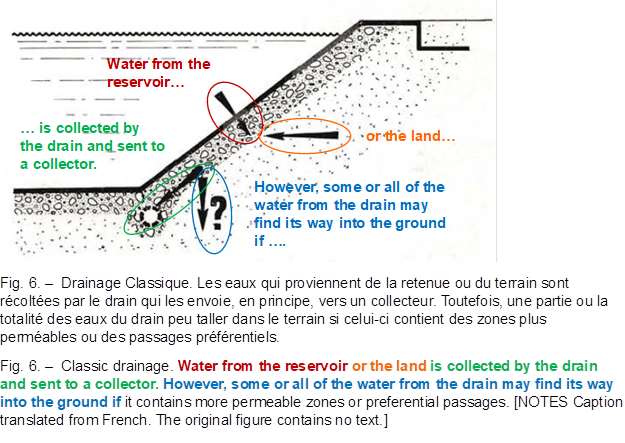
Giroud is fluent both in prose and sketching. Older sketches are hand-drawn and then inked by professional graphic artists. One exquisite example from a 1973 paper in French [8] is the sketch below (Figure 6 in [8]) that truly mirrors the words that accompany it in the caption. Note, for example, the correspondence of the pair arrow–question mark to the text “some or all of the water from the drain may find its way…”. The message is clear: a single waterproofing liner is not enough. This realization provided the inspiration for the concept of double liner, since a leakage detection and collection layer without a secondary liner cannot prevent leakage into the ground. This second message is depicted in Figure 7 in [8] and reproduced in Giroud’s de Mello Lecture [7: Slides 68-69].
Helping the reader navigate figures
Realizing that figures and photographs convey a lot of information, Giroud goes to great lengths to guide the readers focus on the salient features of each one. And he does it again using both sketches and words! We say that “a picture is 1000 words” but not all 1000 are necessary and useful for understanding. Giroud will guide the reader to concentrate on the key 50-100 words. Samples from the exemplar paper mentioned earlier [1] include a juxtaposition of a photograph showing the view of a cut in a karstic formation and a sketch with a cross section through the same formation drawing attention to the karstic cavities (Figures 1 and 2 in paper), and an entire section (Section 3.9) elaborating on a photograph with a geomembrane hole, explaining the shape of the hole and the discoloration of the area around it (Figure 15). Another practice, already mentioned, is the use of generous figure captions; sometimes the caption takes up more space than the figure! Giroud has remarked that a reader in a hurry could approach his papers much like reading a cartoon. Indeed, one can often grasp what the paper is about –and even some of its key messages– simply by examining the figures and their captions.
Using sketches for explaining and thinking
In the above, sketches are used to illustrate thoughts already formed. In Giroud’s work we also have evidence of sketches used as thinking tools. Unfortunately, visual literacy has not been researched for high levels of performance in engineering, so we lack the vocabulary that would help us discern how Giroud uses sketches. If some cognition researchers are interested in doing this work, we know where we would point them to: the several papers where Giroud fights with “categories of what geosynthetics are good for”, also known as functions of geosynthetics. Giroud’s ideas come in waves, starting from 1977 [9]. To this day (2025), neither Giroud nor the geosynthetics community seem to have arrived at satisfactory terms for functions. (Not surprisingly, since function is a philosophical-existential issue.) Let’s go back to the 1977 paper [9], which contains a large number of hand-drawn sketches with applications of geosynthetics, arranged in two “universes”: the hydraulic universe and the mechanical universe. Giroud attempts to bring some order to these two universes by identifying the main role (rôle in French) of the geosynthetic(s) shown in each sketch. Thus, from the two universes of applications, smaller groups of applications emerge, united by the role of the geosynthetic used. The four sketches below are from the hydraulic universe (Fig. 1 in [9]) and depict two roles. A geosynthetic plays the role of drain, i.e. transmits water in its plane, numbers 1 (drainage of the upstream part of an earth dam to ensure stability in the event of rapid drawdown), 2 (prefabricated vertical drains to accelerate soil consolidation), 3 (drainage mat between waterproof geomembrane and concrete pavement to transport water from the concrete during placement, and water percolating through the concrete afterwards) and 4 (drainage curtain collecting leakage water in an earth dam), and the role of a filter, number 15 (filter surrounding the toe drain of a dam).

In his treatises on functions, Giroud leans heavily on sketches up until 1990, when he attempts a systematic categorization of functions for the smaller universe of dams, complete with a proposal for standardizing the lines depicting geosynthetics in engineering drawings [10]. There are two significant differences in later writings. First, the word “role” is replaced by the word “function”, which is the established term nowadays. (The replacement of “role” by the more formal and less flexible “function” may have resulted in a loss of flexibility of thinking.) Second, the ratio of sketches to text decreased. His most recent major exposition on functions in 2023 [11] contains only words. Functions, roles, whatchamacallits: a major open front. An ongoing fight with yet another communication challenge! At a higher level, studying how Giroud used sketches to shape his thinking makes us wonder what we may miss by practically having given up hand sketching.
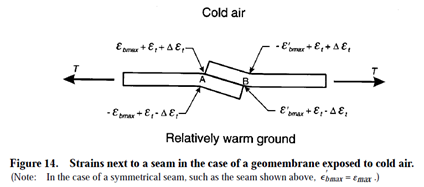
Another example of figures helping both in thinking and explaining is found in the 1995 paper with story-like coherence on strain concentrations next to seams [12] also discussed in the “Researcher” Section. It contains a total of 16 cross sections of seams, including idealizations of the three main types of seams, the corresponding simplifying versions used in analysis, and their deformed shapes. The ample illustrations render a rather esoteric topic –for non geosynthetics engineers– into a true whodunit that gives enough clues to make you continue reading until you finally see it, with your own eyes, why a crack will start at the point predicted by the analysis presented in the paper (point A in figure below), especially on a cold winter night.
Simplicity of words, reinforcement of messages
Kind to his readers, Giroud conveys messages using simple words and repeats essential information either verbatim or in variations, e.g. “what is” may be followed by any combination of: paraphrasing “what is”, contrasting “what is” with “what is not” (hence preventing misconceptions), and an instance or example of “what is”. Often all the above are accompanied by a sketch, e.g. see Section 3.3 in [1] for an explanation of why at failure the average strain of an HDPE geomembrane will be close to the yield strain.
Opening hooks that motivate reading
Giroud helps the reader concentrate with attention catchers such as starting abstracts with questions and, as already mentioned, strong opening lines. Motivating questions in abstracts act as hooks in the brain. Examples include “Why would the owner of a proposed geomembrane-lined facility agree to a cost increase of 20–40% to pay for quality assurance?” [13] and “How impermeable are ‘impermeable liners’? All liners leak, including geomembranes, but how much?” [14]. Memorable opening lines summarize succinctly the topic under study or its broader importance. Examples include “Geomembranes subjected to excessive tensions are often observed to fail in the vicinity of seams” [12] and “Geosynthetics have pervaded geotechnical engineering to the point where it is no longer possible to practice geotechnical engineering without geosynthetics” [5].
Lecturing: Strategic choice and arrangement of few words
Same as his writing, Giroud’s lecturing is also good storytelling, again amply supported by annotated photographs and sketches. Here the signature feature does not take any studying, because it is apparent just by looking at the slides, which are very sparse. Every word on these sparse slides counts! The Geoengineer JP Giroud legacy site includes the slides from six honor lectures (Vienna Terzaghi Lecture, Mercer Lecture, ASCE Terzaghi Lecture, de Mello Lecture, Széchy Lecture, Koerner Lecture). For three of them (ASCE Terzaghi, de Mello, Koerner), the videos are also available. The visitors of the site are invited to see for themselves how easy it is to follow the lectures just by reading the slides. Not only every word on each slide counts. In addition, no extra words are necessary! Giroud writes everything he says, big ideas and details. He crafts short phrases with few words, carefully grouping them on each line to enhance clarity. These short phrases are connected only by logic. A very tall order, maybe inimitable.
Terminology and Standardization
All of the preceding points reflect effective technical communication practices identified through reverse engineering of Giroud’s papers and lectures. As we saw in the “Researcher” Section, Giroud often begins his papers with definitions of key terms, e.g. [11], implicitly acknowledging that precise terminology forms the foundation of effective technical writing. As the next paragraph will show, Giroud is not only meticulous in his use of terminology, but also a creator of new terms. Giroud himself has written about the standardization of graphic symbols for geosynthetics used across various civil engineering applications [15], building on his initial proposal for geosynthetics in dam construction [10]. In addition, he compiled a list of symbols for geotechnical engineering, geotextiles and geomembranes [16], which was adopted in 1985 by the IGS (now International Geosynthetics Society, then International Geotextile Society).
WORDS AS TOOLS, WORDS FOR ENJOYMENT
What is more, apart from a medium for communication, language has been for Giroud a tool under continuous development and lifetime source of enjoyment. In 1976 he coined the terms “geomembrane” and “geotextile” and published them in 1977 [17], in a paper written in French and presented at the conference that now counts as the 1st International Conference on Geosynthetics. (A clipping from the handwritten manuscript of this paper appears on the homepage, with the word GEOMEMBRANES capitalized.) Before these terms got established, geotextiles were referred to as “filter fabrics”, even when not used as filters, and geomembranes as “plastic films”, “impermeable sheets” or “flexible membrane liners”.
We noted that Giroud is fluent both in sketching and prose. He is also fluent in verse! His extracurricular writings include a description in French verses of how equations are discovered. The rhythm and the rhyme are lost in the English translation but the main message comes through.
[…]
Michel-Ange estimait que, tandis qu’il sculptait, [ Michelangelo believed that, as he sculpted, ]
Il découvrait seulement une œuvre qui existait, [ He discovered only a work that existed, ]
[…]
Instrument du destin, sa main quand elle œuvrait [Instrument of destiny, his hand when it worked]
Ainsi ne créait point, mais seulement découvrait. [Did not create, but only discovered.]
Toutes proportions gardées, on peut en dire autant [All things considered, the same can be said]
A propos d’équations publiées de tout temps. [ When it comes to equations published from time immemorial.]
[…]
CLOSING REMARKS FOR THE FIVE-ROLE TECHNICAL PORTRAIT OF JP GIROUD
From the five roles of the technical portrait (Engineer, Researcher, Educator, Leader, Communicator), Communicator is the most intractable. It is possible that Communicator is also the role that makes the other four extraordinary, at least the roles of Educator and Leader. In finishing the portrait, we turned to people who have worked with Giroud and asked them to share any insights or even free-association ideas.
According to those who have worked closely with JP Giroud
SCOTT BERDY
In August 1988, I was seeking a position as a draftsman when I came across a newspaper advertisement for GeoServices, which later became Geosyntec. On August 17th, 1988, I officially joined the team, and from that point forward, JP and I worked closely together. JP is one of the most detail-oriented individuals I have ever worked with, and through him, I was introduced to various terminologies, such as geomembrane and geotextile. I also gained a deep understanding of geosynthetic liner systems.
Over nearly ten years before my transfer to California, I produced thousands of figures for JP’s publications with the International Geosynthetics Society. Some of those works were featured in numerous books. As I became more familiar with his work, I occasionally offered suggestions to improve the clarity of the figures.
Back then, the process was challenging, as we didn’t have AutoCAD software. Every figure was drawn with ink on mylar, using Leroy lettering templates. Any changes were tedious to implement. With the advent of Autodesk, making adjustments became much easier.
Another responsibility I had was developing slides in the darkroom at the laboratory using Polaroid PolaBlue 35mm film. These slides were among JP’s favorite tools to take with him as he traveled the world, delivering presentations as a keynote speaker at international geosynthetics conferences.
JP is truly one of a kind and is often regarded as the father of geosynthetic lining systems. I am fortunate to have worked with him, and he played a significant role in shaping my 36-year career with Geosyntec Consultants.
DAVID ESPINOZA
Before I joined Geosyntec, I knew about JP through his journal publications. Most of his papers were a tour de force: A treatise of the subject derived from first principles. They were thorough, meticulous and well-written.
When I joined Geosyntec, I learned that JP had developed very comprehensive standards for report and drawing preparation for the company. Then, I saw his hand-written beautifully and clearly drafted notes. It was then when I realized that communication was essential for engineers to be successful. JP and I were in different offices. I was in Maryland, he was in Florida. However, his message was clear: whether we write journal articles, engineering reports, hand-written notes, or prepare construction drawings, they had to be clear. I realized then that correct calculations were not sufficient if they were not clearly communicated.
JIE HAN
I was fortunate to have the opportunity to collaborate with Dr. Giroud starting in 2001 to develop a design method for geogrid-reinforced unpaved roads. He was meticulous, paying close attention to every detail in both the derivation and writing process. Furthermore, he was always respectful, seeking my agreement before making any changes.
Dr. Giroud and I co-taught several short courses from 2013 until 2018. Preparing for each course involved countless hours of discussion to ensure precise terminology, accurate content, logical flow, and clear, easily understandable expression. His unique style of presentation allows audiences and readers to easily understand the content by reading through his slides.
Over the years of working with Dr. Giroud, I have learned a great deal from him. One lesson that stands out is the value of perseverance. Perseverance takes time—and with it, patience. In the context of writing, it means reading a piece repeatedly, identifying mistakes or opportunities for improvement, and not settling until we can find nothing left to change or improve. One co-authored journal paper took us five years to complete and went through more than 220 revisions before it was finally published.
Without a doubt, my association with Dr. Giroud has been incredibly rewarding, his impact on my career has been profound. I am deeply grateful and cannot thank him enough for his mentorship, support, and guidance.
ANNE PERRY
I had the honor to work with JP, as his assistant at Geosyntec, from 1987 until he left the firm as Chairman Emeritus in 2001. Our professional relationship continued at JP Giroud, Inc. until his return to Paris in 2016, and even to this day. While JP utilizes engineering reviewers for his extraordinary technical work, he often calls upon me for clarification of English and American context and culture.
JP will always be my mentor whom I have learned so much about the world of geosynthetics through his masterpiece, Geosynthetics Bibliography, Volumes 1 and 2, and many other technical papers. I became a proficient proofreader thanks to JP’s concise instruction to his staff. Proofreading included “bullet proofing”! When word processing a 30-page hand-written document, we often would find many bullet points in the text. He taught us to count the bullets in the written text to compare the ones in the typed text. Often, a missed bullet point would be discovered by the proofreader, then to be returned to the weary word processor for correction. JP also instructed his staff while proofreading his technical papers to carefully look at each word, but using a different technique. Instead of reading the lines in a normal manner, he taught us to read each word backwards, paragraph by paragraph. The eye and the brain tend to scan over many words and phrases without always comprehending an error. Reading the text backwards provided a slower, more methodical way to discover an error or punctuation issue.
Most people know JP as an extremely serious and dedicated man. He is also one of the most hysterically funny men I know. When he required total concentration while working, he would hang witty signs on his door to warn the intruder to STAY OUT! For example, “DO NOT ENTER - I AM IN JAPAN TODAY” (while writing his keynote address for the Kyoto Conference). Or, “STATE OF EMERGENCY - DO NOT ENTER”.
There is no one, and never will be another, like Jean-Pierre Giroud, a true genius who has profoundly dedicated his life to Geosynthetics. He is constantly “working like a monk” and if you are not receiving that accolade from him, you aren’t working hard enough.
GABRIELLA VASCHETTI
I first met JP in 1995 at his Technical Seminar on “Geosynthetics in Dams.” Since then, our professional paths have crossed numerous times. JP's exceptional communication skills stem from his blend of humanistic and technical knowledge, rationality, and clarity—traits befitting a true son of Descartes. His outstanding mathematical abilities, curiosity, multifaceted creativity, focus, and hard work further distinguish him.
As a lecturer, JP taught me that building knowledge requires crystal-clear processes and phrasing, as well as sparking curiosity and enjoyment in the audience. His relaxed presentation style reflects the pleasure he derives from lecturing. When I confided that public speaking often made me nervous, he advised, “Relax, and remember that when you’re up there, you’re the star, the one who holds and must transmit knowledge.”
In written communication, JP exhibits a dual creativity. In technical documents, his analytical approach to problem-solving is matched by his joy in working with equations—he once described manipulating equations as “a vacation.” In his extracurricular writing, his delight in playing with words often leads him to compose classic alexandrine verses. His speech for the Légion d’Honneur and other humorous and delightful verses inspired by everyday events are examples of how his writings impart life lessons with a consciously disenchanted approach.
The lesson I learned from JP is that even without such remarkable talents, the key is not to view work solely as a duty but to find joy in what we do. I am grateful to JP for the privilege of sharing in his performances, collaborating on technical and keynote papers, assisting in meticulous review processes, and being one of his students. I thank him for the irony and fun that accompanied our cooperation. Intelligence and creativity have always driven him, making him perhaps best described as a son of Leonardo.
BOB WALLACE
Characterization of JP as a communicator spans the entire spectrum of the five roles. I worked for him for only three years, but I have valued him as a friend for over 40 years. In the literal sense of Communicator, the thing that distinguishes him is his ability to communicate elegantly in English, although not his native language, and at an eloquent level not exhibited by many native speakers. Over the years, besides collaborating on several publications, I was flattered and happy to assist him with the review of several of his many papers. I am honored that JP refers to me as “my English teacher”. I believe that I have contributed to the final products in most cases, although the pleasure is mine to have assisted this master communicator. There are no specialists in the spectrum of geosynthetics and systems that have not benefited from the eloquence of this true legend of the development of geosynthetics. But to me, JP the communicator, with whom I have enjoyed this long-term friendship, has communicated with thousands of engineers, sharing his keen interest in engineering with us all.
NOTE: We asked Dr Giroud what he means by “my English teacher”. He replied “Bob Wallace has been my ChatGPT – for every English word that gives me trouble, he offers me five alternatives”. Perhaps French tradition – with its reverence for le mot juste – was the perfect substrate for Giroud the Communicator.
REFERENCES
[1] Giroud, J.P., 2019, “Lessons learned from case histories of reservoirs lined with geomembranes”, Revue Française de Géotechnique, Vol. 159, No. 2, 13 p., https://doi.org/10.1051/geotech/2019014
[2] Giroud, J.P., 2000, “Lessons Learned from Failures and Successes Associated with Geosynthetics”, Keynote Lecture, Proceedings of Eurogeo 2, the Second European Conference on Geosynthetics, Bologna, Italy, October 2000, Vol. 1, pp. 77-118. [link]
[3] Giroud, J.P., 1986, “From Geotextiles to Geosynthetics: A Revolution in Geotechnical Engineering”, Proceedings of the Third International Conference on Geotextiles, Vol. 1, Vienna, Austria, April 1986, pp. 1-18. [link]
[4] Giroud, J.P., 2023, “Geosynthetics: The Discipline Beyond the Products”, IGS 40th Anniversary Lecture Series, November 2023. [IGS link] [YouTube link]
[5] Giroud, J.P., 2005, “Quantification of geosynthetic behavior”, Geosynthetics International, Vol. 12, No. 1, pp. 2-27, https://doi.org/10.1680/gein.2005.12.1.2
[6] Giroud, J.P., 2016, “Leakage Control using Geomembrane Liners”, The Victor de Mello Lecture, Soils and Rocks, São Paulo, Brazil, Vol. 39, No. 3, pp. 213-235, https://doi.org/10.28927/SR.393213
[7] Giroud, J.P., 2016, “Leakage Control using Geomembrane Liners”, The Victor de Mello Lecture [link]
[8] Giroud, J.P., 1973, “L'étanchéité des retenues d'eau par feuilles déroulées”, Annales de l'ITBTP, 312, TP 161, Décembre 1973, pp. 94-112. (in French)
[9] Giroud, J.P., 1977, “Les Géotextiles”, Le Moniteur des Travaux Publics et du Bâtiment, 51, Paris, 26 Décembre 1977, pp. 61-67. (in French) [link]
[10] Giroud, J.P., 1990, “Functions and Applications of Geosynthetics in Dams”, Water Power and Dam Construction, Vol. 42, No. 6, June 1990, pp. 16-23. [link]
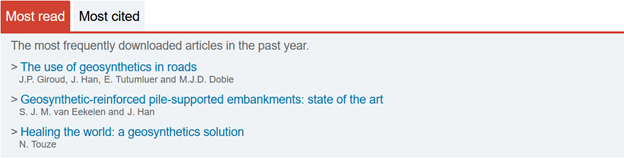
[11] Giroud, J.P., Han, J., Tutumluer, E. & Dobie, M., 2023, “The use of geosynthetics in roads”, Geosynthetics International, 30, No. 1, pp. 47-80, with Supplemental Documents, https://doi.org/10.1680/jgein.21.00046
NOTE: This paper was the most downloaded paper from Geosynthetics International in 2024.

[12] Giroud, J.P., Tisseau, B., Soderman, K.L., & Beech, J.F., 1995, “Analysis of Strain Concentrations Next to Geomembrane Seams”, Geosynthetics International, Special Issue on Design of Geomembrane Applications, Vol. 2, No. 6, pp. 1049-1097, https://doi.org/10.1680/gein.2.0046
[13] Giroud, J.P. & Fluet, J.E., Jr., 1986, “Quality Assurance of Geosynthetic Lining Systems”, Geotextiles and Geomembranes, Vol. 3, No. 4, Elsevier, London, England, pp. 249-287, https://doi.org/10.1016/0266-1144(86)90026-9
[14] Giroud, J.P. & Bonaparte, R., 1989, “Leakage through liners constructed with geomembranes-Part I. Geomembrane Liners”, Geotextiles and Geomembranes, Vol. 8, No. 1, pp. 27-67, https://doi.org/10.1016/0266-1144(89)90009-5
[15] Giroud, J.P., 1991, “Graphic Symbols for Geosynthetics”, IGS NEWS, Vol. 7, No. 3, November 1991, pp. 8-10.
[16] Giroud, J.P., 1985, “Symbols for Geotechnical Engineering, Geotextiles and Geomembranes”, List of Symbols adopted by the International Geotextile Society, Geotextiles and Geomembranes, Vol. 2, No. 3, pp. 243-262, https://doi.org/10.1016/0266-1144(85)90023-8
[17] Giroud, J.P. & Perfetti, J., 1977, “Classification des textiles et mesure de leurs propriétés en vue de leur utilisation en géotechnique”, Proceedings of the International Conference on the Use of Fabrics in Geotechnics, Session 8, Paris, Avril 1977, pp. 345-352. (in French) [link]