EDUCATOR
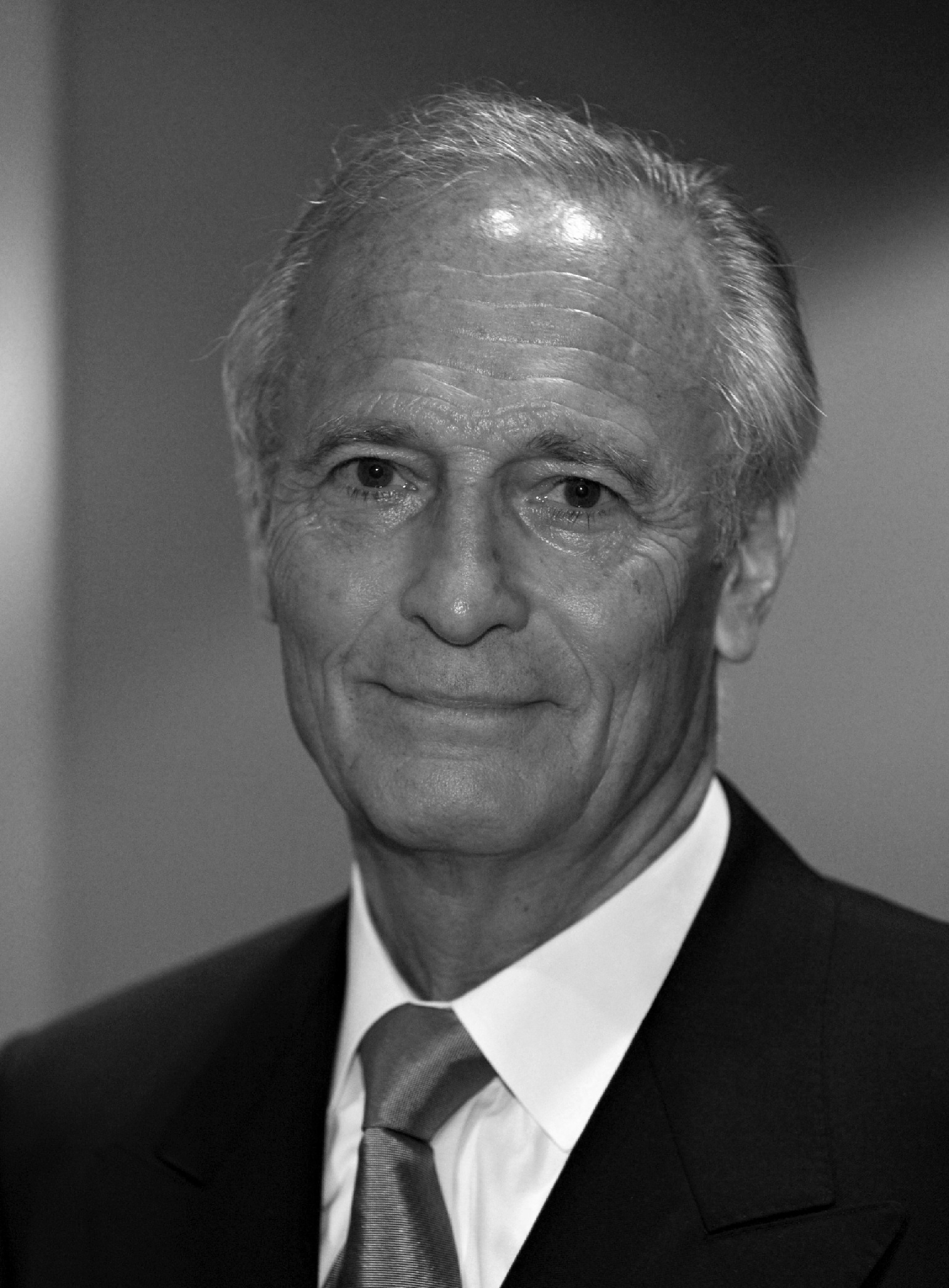
If interpreting educator narrowly to mean university professor, Giroud’s educator career lasted 13 years. More broadly, educators can be defined by their main mission: to help others see and do things in new ways. With this definition, Giroud has been an educator throughout his professional life. Especially after he left academia, his activities as educator –through writings, lectures and seminars– focused on three main targets:
- familiarize geotechnical engineers with geosynthetics;
- extract lessons learned from case studies;
- advocate adherence to quantitative engineering analysis and caution against explanations suggested by not thoroughly cross-checked common sense.
This write-up first lists Giroud’s academic and training engagements, then expands on the three themes he evidently feels strongly educating about, and closes with testimonies from colleagues who interacted with him as younger professionals and researchers.
Academic and training engagements
From the very beginning of his civil engineer career, Giroud combined academia with consulting. His main academic association was with the University of Grenoble, where he was Assistant Professor in 1965-1978 and Director of the Master's Degree Program of Geotechnical Engineering in 1976-1978. In 1971-1978 he was also Professor of Geotechnical Engineering at the Grenoble University Institute of Technology and in 1977-1978 Professor of Geotechnical Engineering at the Ecole Nationale des Travaux Publics in Lyon. In his last two years in France (1976-1978), he taught a short course on soil mechanics at University Paris VI.
After he resigned his professorships at the aforementioned academic institutions in France to become full-time consultant in the US, he continued to teach training courses on geosynthetics for state and federal administrative units in the US, e.g. US Environmental Protection Agency (USEPA), US Bureau of Reclamation (USBR), Association of State Dam Safety Officials (ASDSO), Federal Highway Administration (FHWA), as well as short courses for universities and the industry. The courses for USEPA, USBR and ASDSO were on geomembrane liners and drainage, whereas the courses for FHWA were on roads, embankments and retaining structures.
Geotechnical engineers and geosynthetics
Through his lectures and writings, Giroud has strived for geotechnical engineers to view geosynthetics as all other civil engineering materials that are selected with a sound understanding of their functions, properties and the principles governing their behavior, dimensioned on the basis of quantitative design, and incorporated in geotechnical structures according to construction specifications. As a good educator, he stresses not only what to do, but also what to avoid, e.g. “designing by cartoons” in the case of landfills [1].
When educators choose instruction topics strategically, the roles of educator and leader overlap. In such cases, the role of the leader may be more impactful. For this reason, the geotechnical engineer-geosynthetics thread is further expanded in the “Leader” Section.
Extract lessons from case studies
Giroud systematically distills experiences from practice in a series of “lessons learned” papers with compilations of case studies, including failures. One paper that stands out is “Lessons Learned from Successes and Failures Associated with Geosynthetics”, from the 2nd European Conf. on Geosynthetics, EuroGeo 2000 [2]. For several reasons. As the title denotes, it covers the entire area of geosynthetics. It discusses in detail and defines three types of failure: functional, serviceability and durability. It proposes a template to summarize cases that includes, in addition to type, mechanism, mode, cause and reason of failure. It is unique from an educational point of view: to drive across lessons to be learned, it offers four different perspectives, four different cross-sections of the universe of problems in structures with geosynthetics. (The four perspectives are summarized in Tables 1-4, which can serve as reading guides and maps of contents.) The first perspective is a detailed typology of modes of failure, which are classified in five major categories (leakage, clogging, instability, deformation, degradation) with several subcategories. The second perspective differentiates between failure modes common to soil and structures incorporating geosynthetics (thus underscoring the central role of geotechnical engineers in projects involving geosynthetics) and geosynthetic-specific modes. The third perspective cautions against situations leading to failures, which are mostly attitudes (such as excessive expectations, e.g. “zero-leakage” geomembranes) and misconceptions (e.g. an extra layer of geosynthetic adds desirable redundancy). Finally, the fourth perspective wraps up with a summary of design- and construction- specific lessons, as well as high-level lessons, such as the duty of experts performing forensic analysis to explain failures on a rational basis and not to invoke “engineering judgment” or “common sense”.
Keep at bay common sense with rational analysis
Giroud’s forensic engineering experience helped him observe that failures were often accounted for by easy-to-arrive-at explanations with a common-sense appeal. These were the cases where pieces of evidence that did not match the common-sense account were overlooked or their importance was played down. If properly acknowledged, the common-sense explanation would not stand. The common sense – rational analysis tension is a leitmotif in several of Giroud’s papers, often following presentations of suitable case studies. We saw two such studies in the write-ups for the roles of Giroud as Engineer and Researcher: the Tancarville water reservoir (Engineer) and the Proton Decay Experiment reservoir (Engineer and Researcher). The salient features of both are described crisply in the 2019 paper “Lessons learned from case histories of reservoirs lined with geomembranes” [3], which offers the most convincing argument for rational analysis based on case studies. The Tancarville water reservoir case study concerns the repair of a failure, after the geomembrane liner collapsed over a large karstic cavity. The repair supported by common sense was a stronger material for the liner covering the reservoir bottom. But, the cavity was created by leaking water and new leaks would result in new cavities in the underlying karstic limestone. The rational approach dictated detecting and minimizing leakage with a double-liner system. The Proton Decay Experiment reservoir case study concerns the prediction of failure of the geomembrane lining the reservoir. Common sense suggested that the failure would be unlikely, because the geomembrane material could elongate to a strain of 700%, which presumably was the reason that no such failure had been recorded prior to 1980. The rational approach required studying the entire stress-strain curve, which had a yield stress at a much lower strain of the order of 10%, and led to the prediction that any deviation from the ideal laboratory conditions would result in geomembrane failure at an average strain close to the yield strain. Common sense prevailed, the reservoir was lined without the modifications recommended by Giroud, and the geomembrane failed as predicted. As we will see next, the tendency to trust common sense is a structural feature of our mind. Giroud’s remedy to counter this tendency is sticking to the quantification of the phenomena involved and is communicated with the motto “engineering can only be done with numbers” [4].
Support from the literature of psychology and decision making for the perils of common sense
According to psychologist Daniel Gilbert [5] “…throughout history there have been wonderfully insightful people who have made shrewd guesses about how the mind works. Modern science allows us to decide which one of these guesses was right and which was wrong.” Giroud’s ongoing campaign for rational analysis and against common sense turned out to be one of these shrewd guesses. His observation of the tension between the lulling-to-the-mind common sense and the hard-obtained rational analysis presaged by 30 years Kahneman’s (2011) juxtaposition of fast thinking (akin to common sense) and slow thinking (akin to rational analysis) [6].
In his book “Thinking, fast and slow” [6], Kahneman (the psychologist winner of the 2002 Nobel prize in Economics) explains how we can perceive the mind as having two systems that do the thinking required for decision making and judgment. System 1, which is automatic and often works below the threshold of consciousness, generates fast thinking, and is also responsible for perception and memory. System 2, which is deliberate, generates slow thinking and is responsible for monitoring behavior and checking outcomes of System 1. To better acquaint us with the two systems, Kahneman describes them like two characters with the apt names “A machine for jumping to conclusions” for System 1 (fast thinking, perception, memory) and “The lazy controller” for System 2 (slow thinking, monitoring, control).
Most of us are lazy when it comes to undertaking difficult tasks and relish legitimate – or legitimate-looking– opportunities to avoid them. A key determinant of whether System 2 will undertake the task of checking on System 1, i.e. overcome its laziness, is whether we feel cognitive ease or cognitive strain. The experience of cognitive strain tends to mobilize System 2. On the contrary, the pleasurable experience of cognitive ease, often resulting from familiarity mistaken for truth, is a signal that there is no need for System 2 to intervene. This is the root of the conundrum identified empirically by Giroud: a mistaken impression of a job well done with common sense saves System 2 the hard work to do the job with rational analysis and leaves us with a positive emotion, i.e. without an inkling that we should have worked more.
Kahneman and coworkers (2021) elaborate further on how we are tricked, by our own mind, to trust the soundness of our professional judgements [7]. Trusting our gut and “knowing without knowing why” may create a satisfactory feeling that can be misinterpreted as a signal that closure is achieved. What makes this signal important and tricky is that we perceive it not as a feeling but as a belief. The satisfying emotional experience is misperceived as rational confidence in the validity of the judgement. Kahneman et al. (2021) provide quantitative evidence for the percentage of accurate predictions resulting from professional judgment; the percentages are similar to Giroud’s estimate that common sense only by chance will be correct: “common sense in engineering is as reliable as tossing a coin and more dangerous since it is more believable” [8].
Being on the receiving end: Associates reflect on teachable moments
To complete the picture of Giroud the educator –in the broad sense– we asked graduate students of his in Grenoble and younger associates in Geosyntec to share experiences they may have with Giroud in a role of mentor-educator. In particular, we asked them to share if they had any “teachable moments” from their years of working with Giroud. Let’s hear them.
ROBERT BACHUS
Explain/Defend Your Opinions: For an early presentation that I gave when JP was in the audience, I cited regulatory requirements for the soils used as a compacted clay liner, specifically the limits on lift thickness, maximum particle size, maximum percentage of large particles, molding moisture content and Atterberg limits. When I showed the slide, JP asked “Why are those the recommended limits?” While some of the limits may be intuitive, I was not prepared to explain/defend the limits on plasticity. After giving it some thought and thinking out loud, I/we arrived at an explanation. I learned that I needed to be prepared to explain the reasons for my opinions. Since that episode, I now always ask myself “why?” when making a recommendation.
Be Specific: When making technical points in a presentation or publication, it is insufficient to make a general statement without citing a specific example. For example, in comparing the FHWA equations for geotextile filter criteria to those proposed and advocated by JP, it is easy to cite the differences and opine that “JP’s criteria are preferred for landfill applications.” It is more difficult (but necessary) to cite specific differences and the reasons why one is better/preferred for a specific application. In this specific case the differences relate to favoring retention over the permeability criterion.
Do Not Lose Sight of the Big Picture: When working on a project with JP, the client took issue with something we did. This bothered me to the extent that I had trouble sleeping that night. At 3:00am I got up and spent 2 hours drafting notes that I would use in the next day’s meeting to explain/summarize why his opinion was incorrect. At breakfast, I proudly showed my talking points to JP. After hearing me pontificate on these issues, JP said “… I completely agree with you. Those points are exactly correct. Now, do you know what you are going to do?” Pleased that he agreed with me, I said that I would make a presentation to the client during the meeting to explain my position. JP said “…No, here is what you are going to do!” He then reached across the table, took my notes, and tore them up! He then explained that while we were correct, those points did not matter when we looked at the major issue(s) for the project. It would do us no good to argue with the client and create a rather hostile environment. What I learned from JP were two points (pardon the cliché): (i) do not lose sight of the Big Picture; and (ii) pick your battles carefully, remembering that the goal is to not necessarily win every battle as long as you win the war.
Look For Opportunities to Contribute, Share, and Mentor: JP wrote (and still writes) a lot. He does this to share his knowledge and experiences with the profession. However, if you look at his papers, you usually will find co-authors from within the firm/industry, many of them younger staff. I was privileged to be among them. When JP would ask if I (or another colleague) would be interested in writing a paper with him, we obviously jumped at the opportunity. The next thing we saw was a paper that was about 95% complete… he did the lion’s share of the work. While I/we provided a thorough review, lively discussion, and added some text, what we realized was that he was providing not only the opportunity to contribute but subtly instilled in us the value of helping and mentoring younger staff. Since that time, I have had the opportunity to be invited to “co-author” papers with my colleagues and have asked my colleagues to “co-author” papers with me… following the JP teaching model.
KWASI BADU-TWENEBOAH
I joined Geosyntec (then GeoServices) in December 1987 and worked with JP on projects and research work until his retirement from the firm in 2001. Since then, I have continued to collaborate with him on geosynthetics and landfill projects and publications.
In 1998, I had the pleasure to work with JP on a project for the siting, design, and permitting of a low-level radioactive waste disposal facility in North Carolina. JP, then Chairman Emeritus of Geosyntec, was tasked with the evaluation of the long-term performance of a proposed engineered final cover for the facility. JP and I traveled to Raleigh, North Carolina to participate in a technical meeting with the client and other experts to discuss the project. This was the first and only time I had the opportunity to travel with JP on a project.
During the meeting we discussed, among others, an infiltration rate analysis during and after the post closure care period (0 to 100 years and 100 to 500 years, respectively). We presented calculated infiltration (or leakage) rates for typical sizes and frequency of geomembrane defects at the meeting. A question was asked about what the leakage rate would be if the defect size was increased, which I then immediately pulled out my pocket calculator to check. JP quickly nudged me to stop and on our ride back to the airport, he advised me of “not providing free consulting when not needed”. This was and has been a teachable moment for me during my consulting career and I’m proud to say that I have passed this on to my colleagues and junior staff since then.
Thanks, JP, for this teachable moment!
JAY BEECH
I was fortunate to work closely with Dr. Jean-Pierre Giroud during the early days of liner system design when many of the design approaches used today were developed. While the technical work was exciting, a memorable teaching moment from JP is related to writing. He was reviewing a report I wrote and noted that a topic in the report was addressed in two sections of the report. He explained that in a well-organized report one only addresses a topic once. A re-organization of the report outline was the solution. I carried this lesson through my career, especially in project specifications where conflicting information can confuse a contractor and potentially lead to change orders.
RUDOLPH BONAPARTE
Dr. Jean Pierre Giroud has been my mentor, colleague, and friend for more than 40 years - since we were introduced by Dr. Yves Lacroix at Woodward-Clyde Consultants in 1982. Jean-Pierre co-founded Geosyntec in 1983. Over two decades, we collaborated on numerous consulting and research projects, notably including a series of technical research reports for the U.S. Environmental Protection Agency in the 1980s and 1990s on the design and performance of waste containment systems. From Jean Pierre, I learned a lot about analytical rigor and how to achieve technical excellence in a consulting engineering firm. A teachable moment I remember well was his admonition to not be over-reliant on professional judgement and your “gut feeling.” Your judgement should always be complemented with appropriate engineering analyses. Hopefully, the two approaches lead to the same solution, but if not, you need to get to the bottom of why they do not agree. This process leads to a deeper understanding of the problem and greater confidence that you have found the right solution. Jean Pierre imbued Geosyntec with that culture, which still exists today.
JEAN-PIERRE GOURC
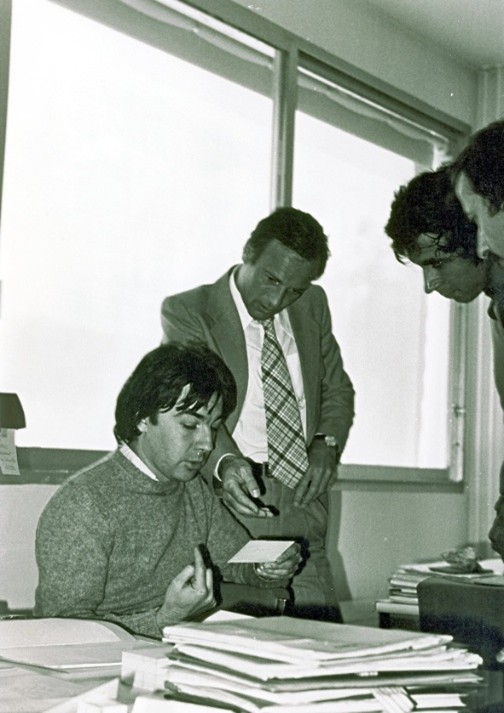 |
It is in 1977, shortly before the departure of JPG for the USA and a first job in Chicago. I'm with Philippe Bally and Yves Faure, two of my PhD students of the laboratory LIRIGM (Laboratoire interdisciplinaire de recherche impliquant la géologie et la mécanique), at the University of Grenoble. We are discussing with JPG about the first experimental hydraulic results, on samples of nonwoven geotextiles retrieved on the famous site of the Valcros Dam in France. It was exciting because it was the result of a pioneering research work. No device, no process existed previously for testing this kind of material, specifically in a geotechnical laboratory. Thanks to Jean-Pierre, I was starting a new scientific adventure, on this new research topic!
[NOTE For Valcros Dam, see Section "Engineer"] |
References
[1] Giroud, J.P., 2023, “Geosynthetics: The Discipline Beyond the Products”, IGS 40th Anniversary Lecture Series, November 2023. [IGS link] [YouTube link]
[2] Giroud, J.P., 2000, “Lessons Learned from Failures and Successes Associated with Geosynthetics”, Keynote Lecture, Proceedings of Eurogeo 2, the Second European Conference on Geosynthetics, Bologna, Italy, October 2000, Vol. 1, pp. 77-118. [link]
[3] Giroud, J.P., 2019, “Lessons learned from case histories of reservoirs lined with geomembranes”, Revue Française de Géotechnique, Vol. 159, No. 2, 13 p., https://doi.org/10.1051/geotech/2019014
[4] Giroud, J.P., 2005, “Quantification of geosynthetic behavior”, Geosynthetics International, Vol. 12, No. 1, pp. 2-27, https://doi.org/10.1680/gein.2005.12.1.2
[5] Gilbert, D., 2006, “Stumbling on happiness”, Harper Perennial, 277 p.
[6] Kahneman, D., 2011, “Thinking, fast and slow”, Penguin Books, 499 p.
[7] Kahneman, D., Sibony, O. and Sunstein, C.R., 2021, “Noise, A flaw in human judgement”, William Collins, 452 p. (Because geotechnical engineering has a long history of revering judgment, readers may be interested in reading the original passage referenced from Chapter 11, pp. 138-139, starting with: “One review of intuition…”.)
[8] Giroud, J.P., 1984, “Analysis of Stresses and Elongations in Geomembranes”, Proceedings of the International Conference on Geomembranes, Vol. 2, Denver, CO, USA, June 1984, pp. 481-486. [link]